Written by Murad Rajeh Shally
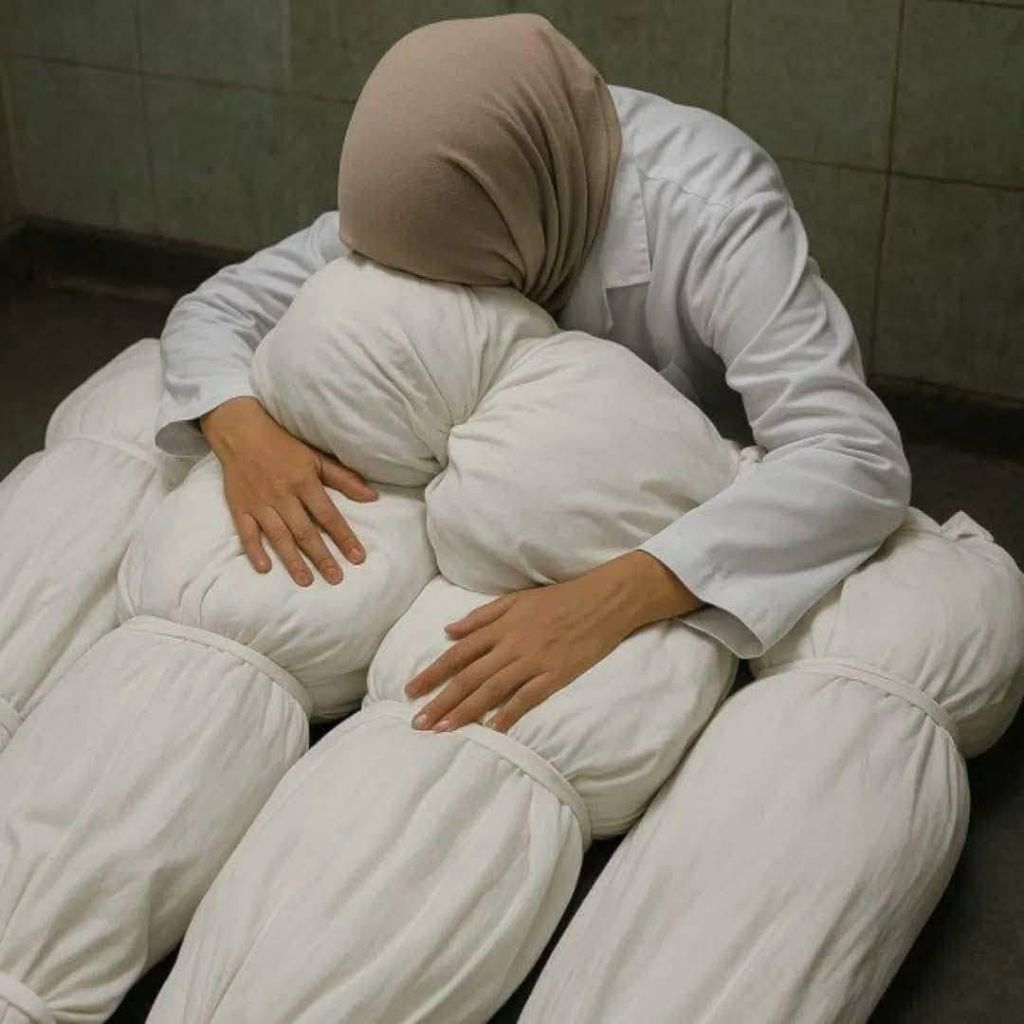
Dr. Alaa Al-Najjar, a pediatrician at Tahrir Hospital in Nasser Medical Complex, was preparing to leave the house after she promised her eldest child Yahya to prepare a group birthday party and invited her ten children after her husband Dr. Ahmed insisted on driving her out of fear for her to the hospital near the house, which is not more than ten minutes away, but due to the increase in Israeli shelling and the abundance of rubble along the road, the time to reach the hospital increases.
The two of them left the door of the family home and suddenly Dr. Alaa went back and opened the door amid her husband’s surprise and rushed towards the dormitory of her one-year-old baby girl Cedar, who watches her with an angelic smile on her little face, watching her and hugging her gently, then calling for her children again and hugging them as if she was on her last date to part with them.
She left them and ran towards the door of the house with teary eyes and a frightened heart, where her husband was waiting for her, who asked her a question while putting his right hand on her shoulder:
- What’s wrong, Umm Yahya, you scared us all.
She couldn’t wait and cried softly as she buried her face in her palms and answered him: - I’ve had a bad feeling, Abu Yahya, since yesterday evening.
He patted her on the shoulder and spoke to her in a calm voice - He pats her on the shoulder and speaks to her in a calm voice: “Don’t worry, there are children who need you in the hospital to heal them.
She replied, exhaling the pain in her chest: - “Yes, let’s go, we’re late.
With her heart inexplicably aching, she got into the car next to her husband, trying to reassure herself that everything would be fine, while the scene of her last hug with her children raced through her mind. Cedar’s little laugh kept echoing in her ear, like a distress call from the future, as if her little eyes were begging for survival.
The drive to the hospital was longer than usual, not by time, but by the weight of fear and the unknown. The sound of airplanes is never absent, smoke rises from the outskirts of the city, and the sound of alarms is more familiar than the muezzin’s voice.
Alaa arrived at the emergency department of the Nasser Complex, and as soon as she stepped inside, the news started pouring in: dozens of people were injured, and the hospital could barely accommodate them. Her body was occupied there, but her heart remained at home, imagining every possible scenario and hoping that none of them would materialize.
It wasn’t long before a nearby explosion rang out, the hospital’s windows shook, dust fell from the ceiling, doctors and nurses rushed outside, and several ambulances poured into the gate, laden with the remains of children and women, and one of the vehicles was filled with bodies. Charred bodies covered in white aprons.
In an instant, a paramedic gasped as he called out: “They came from the al-Salam neighborhood… the al-Najjar house… it was completely hit.”
Alaa froze in place, as if time had stopped, as if she was being ripped out of her body, and the letters felt like knives digging into her chest. She tried to scream, to run, to deny, but her feet failed her.
She fell to her knees, whispering like crazy: “No… no… my children are there… they were playing an hour ago…” She ran, racing against time, against hope, against pain, until she reached the morgue.
Her feet stopped at the threshold of the room. Nine small coffins covered in charred black clothes, smelling of burnt flesh. She approached with heavy steps, and suddenly she broke. Among the coffins, she noticed a golden lock of hair clinging to a torn piece of cloth… It was little Rival’s, her five-year-old daughter’s
Rakan’s school shoes, Eve’s gold bracelet, Arslan’s burnt doll. Each item was a death poem reminding her that the Israeli aggression had stolen even their simple dreams:
Alaa collapsed on top of the bodies, leaving her white medical gown stained with the blood of her sons. In the corner, her colleagues stood silently weeping, unable to comfort a mother who had just calmed babies.
It is a scene that neither the mind nor the heart can bear, Dr. Alaa stood in front of the refrigerators of the dead, looking at the bodies of her little ones, hugging their corpses, distinguished only by the mother’s heart… They were the ones she carried as babies on her chest, watching over their illness, watching their growth, and smiling at their small dreams. The dream turned into a nightmare, and the mother became a witness to her family’s holocaust.
This is how Dr. Alaa al-Najjar lost everything in an instant… Her children, her home, and her husband, who is fighting for his life, while the world is silently watching one of the most heinous crimes documented only by the tears of a mother crying for her children inside the hospital where she was saving their lives.
In the evening. Dr. Alaa was trying to open the closet of her destroyed house, waiting for her children to come out of it as they used to do in hide-and-seek… But the abominable enemy did not leave even their ghosts.
This was the story of the tragedy of Dr. Alaa, the mother who received the bodies of her nine children, telling the world that it is not just a passing tragedy, but an open wound in the heart of humanity.
 Dissentopia