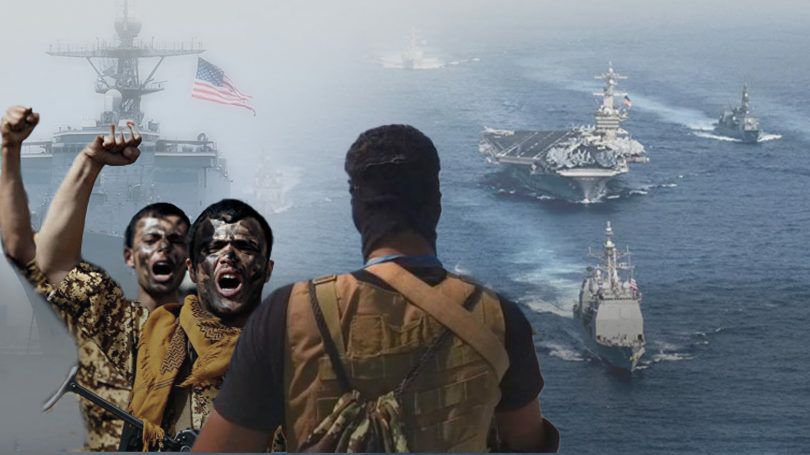
Washington, D.C. With its historic defeat in confronting Yemen and its blatant failure to deter the Yemeni support front for Gaza, the United States is torn between its strong desire to take revenge on the Yemeni people to cover up that defeat and that failure, and the lack of effective options to implement this desire, after the armed forces proved their credibility to the shipping sector by stopping naval operations on ships not owned by the Zionist enemy, and the response of many ship operators to this. After the armed forces proved their credibility to the shipping sector by stopping maritime operations on ships not owned by the Zionist enemy, and the response of many ship operators to this, Washington has shown a rush to try to internationalise its predicament by presenting the Red Sea as an area of constant danger to all, and calling for the formation of new alliances that include regional countries, in a new effort to mobilise against Yemen behind the new classification decision, this time for clear and obvious vindictive and political purposes that false claims of “protecting navigation” cannot conceal.
Shipping companies trust Sana’a’s credibility:
Since international news agencies and shipping platforms revealed that many shipping companies had received letters from the Humanitarian Operations Coordination Centre in Sana’a regarding the lifting of sanctions on ships not owned by the enemy entity (linking the lifting of sanctions on enemy vessels to the completion of the Gaza ceasefire agreement) Many reports quoted maritime security officials as saying that many ship owners are working to arrange a return to the Red Sea, and that the slowdown is due to two reasons: The first is to ensure that the Gaza ceasefire holds, and the second is the time needed to plan the return to avoid disrupting supply chains and congestion.
The Wall Street Journal confirmed this week that many ship operators [not owned by the enemy, of course] intend to return to the Red Sea as soon as the second phase of the ceasefire, which is supposed to ensure the end of the war and the completion of the prisoner exchange, is complete, suggesting that the first part of the shipping companies’ concerns is due to a lack of confidence in the enemy’s commitment to the agreement.
The second part of the ship operators’ concerns relates to the complexity of the arrangements needed for the return of sailing through the Red Sea in terms of congestion and the sudden disruption of freight rates, which means it is only a matter of time if the Gaza ceasefire holds, according to two executives quoted by the US newspaper.
The US seeks to form a new “vindictive” coalition against Yemen:
The US is trying to paint a different reality by continuing the disinformation campaign that has failed for a whole year to convince the world that the Red Sea has become a dangerous area for international trade and that all ships are targeted without exception, in an attempt to undermine the credibility of Sana’a, which reports have confirmed that shipping companies mainly trust it. Several Western and British reports have recently stated that ship owners are not relying on US moves but are “waiting for a signal” from Sana’a to return to the Red Sea, and that signal has clearly come.
These misleading US efforts come in an attempt to keep the field open for regional and international mobilisation against Sanaa, especially after the recent decision to designate Ansar Allah, which Washington is counting on using as a cover and a means to lure or intimidate some regimes hostile to Yemen in order to escalate against the Yemeni people.
However, the propaganda of “protecting freedom of navigation”, which the US failed to promote for more than a year during the Yemeni attacks, seems less marketable today than it used to be, and is overshadowed by the clearly stated retaliatory desire on the part of the US, as expressed in the text of the designation decision, whose justification explicitly indicated that it comes as an attempt to avenge the US Navy’s defeat and neutralise the threat that Yemen has become to the enemy entity and US interests and tools in the region, thus proving – inadvertently – the credibility of Sana’a’s declared position regarding the limitation of the threat of naval and other support operations to the enemy entity and the aggressor parties in Yemen. Sana’a’s stated position that the threat of naval and other support operations is limited to the enemy entity and the aggressor parties against Yemen.
This is also what the US intelligence-linked Washington Institute for Near East Policy confirmed in a new report in which it claimed that the Red Sea remains a dangerous area, but in its attempt to explain that danger it said that “even if the Gaza ceasefire leads to a significant decrease in attacks in the Red Sea, it will not change the nature of the Houthis or their hostility towards the United States, the United Kingdom, and Israel.” This is also what the US intelligence-linked Washington Institute for Near East Policy confirmed in a new report. Despite numerous US and British air strikes against Yemen, they still possess a sophisticated arsenal that includes ballistic missiles, cruise missiles, and long-range attack drones.” This means that the threat the US is trying to promote in the Red Sea is limited to the trio who already have hostile orientations against Yemen, not an “international” threat.
While the Institute suggested that the United States and its “partners” coordinate to maintain a military presence in the Red Sea and create “new alliances that include Red Sea states such as Egypt, Eritrea, Saudi Arabia and Sudan,” the title “maintaining the security of the sea lane” that it tried to put for these steps does not fit the specific concerns that it mentioned as “threats.” Egypt, Saudi Arabia, Sudan and Eritrea have no interest in engaging in an alliance whose primary goal – as the Institute stated – is to neutralise the threat posed by the Yemeni armed forces to the enemy’s entity and US and British hegemony over the Red Sea and the Bab al-Mandeb. Egypt, Saudi Arabia, Sudan and Eritrea have no interest in engaging in a coalition whose primary objective is to neutralise the threat posed by the Yemeni armed forces to the enemy entity and US and British hegemony over the Red Sea and Bab al-Mandab, and it is not logical that these countries consider the rise and survival of Yemen’s military capabilities as a threat that they must move to eliminate.
Accordingly, it is clear that the US regional mobilisation attempt against Sana’a is aimed at avenging the historic defeat suffered by the US and British navies in neutralising the strategic Yemeni threat to the Zionist enemy entity, and that the titles “protecting navigation” or “Yemen’s threat to US partners” are nothing but desperate and exposed attempts to win over some parties that already have a pre-existing hostile orientation against Yemen, or to blackmail others that do not have such an orientation.
In fact, the emergence of the US’s retaliatory orientation and special fears in this way represents a prior proof of the inevitability of the failure of aggressive mobilisation efforts against Yemen, whether at the level of the size of the mobilisation or its results.
This is also confirmed by the reality of Washington’s previous and abject failure in mobilising its allies within the so-called “Guardian of Prosperity” operation a year ago, where the coalition ended up being limited to the US and Britain The European Union even resorted to forming an independent operation that it was keen to describe as “defensive” to avoid getting involved in the US and British aggressive battle, and the reality will not be different today with the US openly talking about its desire to avenge its shameful defeat against Yemen, a desire that undermines the “protection of navigation” propaganda that has already been proven to be a failure
 Dissentopia